How to Choose the Right Mould Protector Vision Camera System for Injection Moulding
Manufacturing efficiency depends on multiple interconnected factors, including workflow design, machine selection, automation level, and process control. The choice of moulding equipment has a direct impact on production efficiency for manufacturers producing plastic components at scale.
Vertical injection molding machines are used by manufacturers to improve throughput, reduce manual handling, and support insert-based production. The vertical clamping configuration affects part production, operator and automation interaction with the mould, and the floor space required per moulding cell. This article outlines how vertical injection moulding machines contribute to manufacturing efficiency and where their advantages apply. Efficiency outcomes depend on machine configuration, mould design, material, and process optimisation, not on machine type alone.
Key Takeaways
- Vertical injection molding machines can support manufacturing efficiency through improved workflow design, insert handling, space utilisation, and automation compatibility.
- Gravity-assisted insert stability makes vertical machines particularly suited to insert moulding and overmoulding applications.
- A compact machine footprint allows more production capacity to be installed within the same floor area.
- Automation and repeatable process control help maintain consistent quality across long production runs.
- Energy efficiency depends on drive type, machine sizing, and cycle optimisation rather than machine orientation alone.
- Overall efficiency depends on machine configuration, mould design, material, production requirements, and process optimisation — not on the machine type by itself.
Why Production Efficiency Matters in Plastic Component Manufacturing
Manufacturers producing plastic components at volume are under continuous pressure to reduce cycle time, minimise scrap, and make better use of floor space and labour. Even small inefficiencies in a moulding cell — a slow insert-loading step, an oversized machine footprint, or inconsistent cycle timing — compound significantly across high-volume production runs.
Because moulding equipment sits at the centre of this process, the machine’s configuration influences far more than part quality. It affects how a production line is laid out, how much manual intervention is required, and how easily automation can be integrated. This is why manufacturers in automotive, electronics, medical devices, and consumer goods increasingly evaluate vertical injection moulding machines as part of their efficiency planning, rather than treating machine selection as a separate, later-stage decision.
How Vertical Injection Molding Machines Support Manufacturing Efficiency
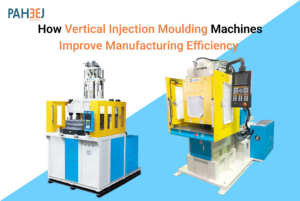
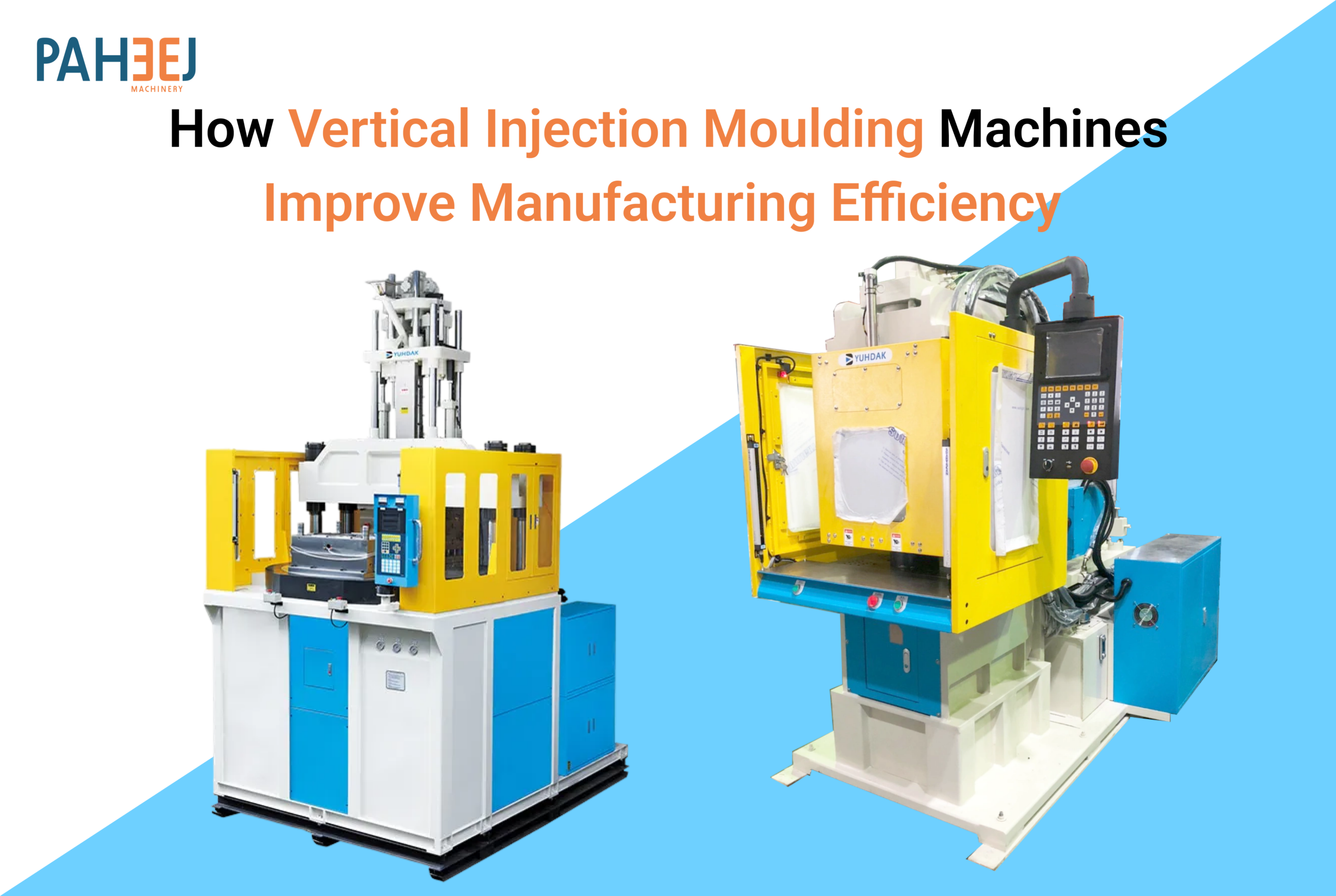
A vertical injection moulding machine clamps the mould between an upper and lower platen that close along a vertical axis, with the mould itself sitting in a horizontal plane. This orientation offers several characteristics that contribute directly to production efficiency.
- Gravity-assisted insert stability: Inserts placed into the lower mould half are held in position by gravity during clamping, reducing the risk of displacement. This lowers scrap and rework linked to insert shift, particularly for small metal or wire inserts.
- Open, top-down mould access: The horizontal mould-parting layout gives operators and robotic systems clear access to the cavity, making insert loading and part removal faster and less error-prone than in more enclosed mould configurations.
- Compact machine footprint: Vertical machines generally require less floor space than horizontal machines of similar clamping tonnage, since the clamping unit extends vertically rather than horizontally.
- Rotary and shuttle table compatibility: Many vertical machines support rotary or shuttle tables, allowing insert loading to take place at one station while moulding occurs at another, reducing idle time in the overall cycle.
These characteristics are the basis for the efficiency benefits discussed in the sections below, covering workflow, insert moulding, space utilisation, labour, automation, quality, and operating costs.
Key Ways Vertical Injection Molding Machines Improve Efficiency
- Production workflow and cycle efficiency — Rotary/shuttle table setups and open mould access reduce non-productive time between cycles, particularly for insert-heavy parts, supporting more consistent cycle timing.
- Insert moulding and overmoulding — Gravity-assisted insert retention improves positioning accuracy for connectors, terminals, threaded inserts, and overmoulded wires, reducing scrap linked to insert displacement.
- Space utilisation — A smaller machine footprint allows more moulding cells to be installed within the same floor area, supporting denser and more efficient plant layouts.
- Labour and handling efficiency — Ergonomic, top-facing mould access reduces operator strain and handling errors during manual insert loading and part removal.
- Automation and repeatability — Open mould access simplifies robotic insert loading, part removal, and inline vision inspection, supporting consistent output across long production runs.
- Product quality and defect reduction — Stable insert positioning and consistent clamping parameters reduce shot-to-shot variation and defects related to insert shift or incomplete encapsulation.
- Energy and operating-cost efficiency — Electric and hybrid drive systems, shorter cycle times, and reduced rework all contribute to lower energy consumption per part produced.
Insert Moulding and Overmoulding in Detail
Insert moulding and overmoulding represent one of the strongest efficiency cases for vertical machines. Because the mould closes vertically, an insert is supported by gravity rather than relying solely on mechanical retention, which reduces the likelihood of displacement during clamping.
This is relevant across several component types:
- Metal terminals and contacts embedded in connector housings
- Threaded inserts used in enclosures and structural housings
- Wires, cables, or sensor leads overmoulded into a plastic body
- Pre-formed sub-components combined with a second material or colour
For manufacturers producing components with strict cleanliness and biocompatibility requirements, insert stability and process control are especially important. Paheej’s resource on vertical injection moulding for medical device manufacturing covers how these factors apply in regulated production environments.
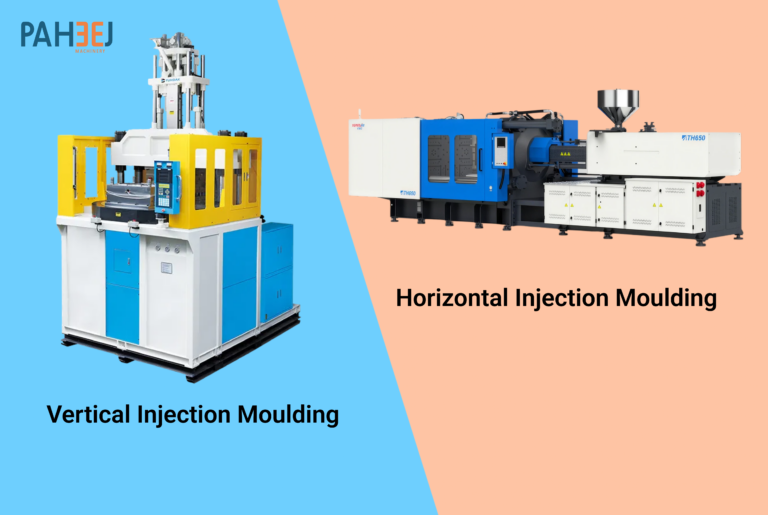
Vertical vs Horizontal Injection Molding for Manufacturing Efficiency
Both vertical and horizontal machines are widely used across plastics manufacturing, and their efficiency benefits vary by application. The table below outlines general differences relevant to production efficiency.
Feature | Vertical Injection Molding | Horizontal Injection Molding |
Insert Stability | High — gravity-assisted | Moderate — depends on fixturing |
Automation Compatibility | Excellent, open mould access | Good, but access more limited |
Floor Space Requirement | Compact | Larger |
Suitability for Insert/Overmoulding | Highly suitable | Application dependent |
Suitability for Large, Simple Parts | Limited by tonnage range | Well suited |
Typical Cycle Consistency (insert parts) | High | Moderate |
For components involving inserts, wires, or embedded elements, vertical machines generally offer a stronger efficiency case. Horizontal machines remain a practical choice for larger, simpler parts that do not require insert placement.
Energy and Operating-Cost Considerations
Operating cost is a core part of any efficiency evaluation, and energy consumption is an increasingly important factor for manufacturers. Several elements influence the energy profile of a vertical injection moulding machine:
- Drive type — electric and hybrid drive systems typically consume less energy than hydraulic systems, particularly during idle or holding phases.
- Cycle efficiency — shorter, more consistent cycles reduce the energy used per part produced.
- Reduced rework — fewer rejected parts means less material, energy, and machine time spent on reprocessing.
- Correct machine sizing — a machine matched to the part and tonnage requirement avoids the energy waste of running an oversized machine for a small component.
Manufacturers assessing total operating cost rather than upfront price alone may find it useful to review how drive technology affects this balance. Paheej’s article on how electric injection moulding machines support sustainable manufacturing explains this relationship in more detail.
Factors to Consider Before Selecting a Vertical Injection Molding Machine
Efficiency gains are not automatic — they depend on selecting a machine configuration suited to the actual application. Manufacturers should evaluate:
- Part design — size, geometry, and whether inserts are required
- Material — resin type, flow characteristics, and any engineering-grade requirements
- Production volume and takt time targets — expected output and cycle time requirements
- Insert and automation requirements — manual loading, semi-automated fixtures, or full robotic integration
- Mould configuration — single-cavity, multi-cavity, family mould, or rotary/shuttle table setup
- Available floor space — how the machine fits into the existing plant layout
- Total operating cost — energy consumption, maintenance needs, and expected scrap rates
Machine Selection Considerations for Manufacturing Efficiency
Consideration | Why It Matters |
Clamping Force | Must match part size and cavity pressure requirements |
Injection Capacity | Should align with shot size and material type |
Insert Requirements | Drives decisions on rotary tables or fixed insert stations |
Material | Engineering resins may require specific screw and barrel designs |
Production Volume | Impacts cavity count and cycle time targets |
Automation | Affects mould design, robot interfaces, and control integration |
Floor Space | Determines how many cells can be installed in the available area |
Drive Type | Influences energy consumption and long-term operating cost |
Getting these variables right at the selection stage helps avoid costly reconfiguration later and ensures the machine supports both current and future production requirements.
How Paheej Helps You Select the Right Vertical Injection Molding Machine
Selecting a vertical injection moulding machine for manufacturing efficiency involves weighing part design, material, insert requirements, automation needs, and production targets together, rather than in isolation. Paheej Machinery works with manufacturers to evaluate these factors as a combined set, rather than recommending equipment based on clamping tonnage alone.
Paheej’s approach typically starts with understanding the specific component, material, expected production volume, and whether insert placement or overmoulding is required. From there, machine configuration — including automation compatibility, drive type, and rotary or shuttle table requirements — can be assessed against the manufacturer’s actual production goals.
As a supplier of vertical injection moulding machines, Paheej also offers all-electric and multi-component/2K injection moulding machines for manufacturers whose requirements extend beyond single-material components. Manufacturers evaluating equipment for efficiency-focused production can get in touch with Paheej to discuss their specific application.
Conclusion
Vertical injection molding machines can meaningfully support manufacturing efficiency through improved workflow design, insert handling, space utilisation, and automation compatibility. These benefits are most apparent in insert-heavy, high-mix, or automation-driven production environments.
Selecting the right machine, however, depends on matching clamping force, mould configuration, material compatibility, and drive type to the specific application — efficiency is a function of the whole system, not the machine alone. Manufacturers evaluating vertical injection moulding equipment for their production line can contact Paheej Machinery to discuss their component, material, and volume requirements.
Frequently Asked Questions (FAQs)
What types of parts benefit most from vertical injection moulding?
Parts requiring insert placement, overmoulding, or embedded components — such as connectors, terminals, sensor housings, and wire-overmoulded assemblies — tend to see the most efficiency benefit.
Are vertical injection moulding machines suitable for large or high-volume parts?
They are generally better suited to small and mid-sized components. Very large parts are usually more practically produced on horizontal machines with higher tonnage ranges.
Does using a vertical injection moulding machine reduce energy costs automatically?
No. Energy efficiency depends on drive type, machine sizing, and cycle optimisation. A correctly specified vertical machine can support lower energy consumption, but this is not automatic.
How does mould design affect the efficiency of a vertical injection moulding machine?
Mould design has a major influence on cycle time, defect rates, and insert handling. Even a well-suited machine configuration will underperform if the mould is poorly designed for the part or material.
Do vertical injection molding machines always produce parts faster than horizontal machines?
Not necessarily. Cycle speed depends on part design, mould configuration, and automation setup. Vertical machines tend to offer the clearest efficiency advantage in insert-heavy or automation-integrated applications rather than simple, non-insert parts.