How Vertical Injection Molding Supports Medical Device Production
Medical devices demand exceptional precision, consistency, and reliability throughout the manufacturing process. Vertical injection molding for medical devices supports these requirements by providing accurate insert positioning, repeatable molding cycles, and efficient automation capabilities. From surgical instruments to diagnostic equipment and medical connectors, vertical injection molding machines help manufacturers produce high-quality plastic components that meet the demanding standards of the healthcare industry.
Why Precision Matters in Medical Device Manufacturing
Medical components often perform critical functions where even minor dimensional variations can affect product performance or assembly. Manufacturers must consistently produce parts with tight tolerances, repeatable quality, and reliable mechanical properties.
Medical device production also involves small, complex components that require accurate molding and stable process control. Whether manufacturing disposable products or reusable medical equipment, maintaining consistency across every production cycle helps reduce defects, minimize waste, and support quality management requirements.
As production volumes increase, manufacturers also require equipment that delivers the same level of precision throughout extended manufacturing runs.
Vertical Injection Molding Supports Medical Device Production
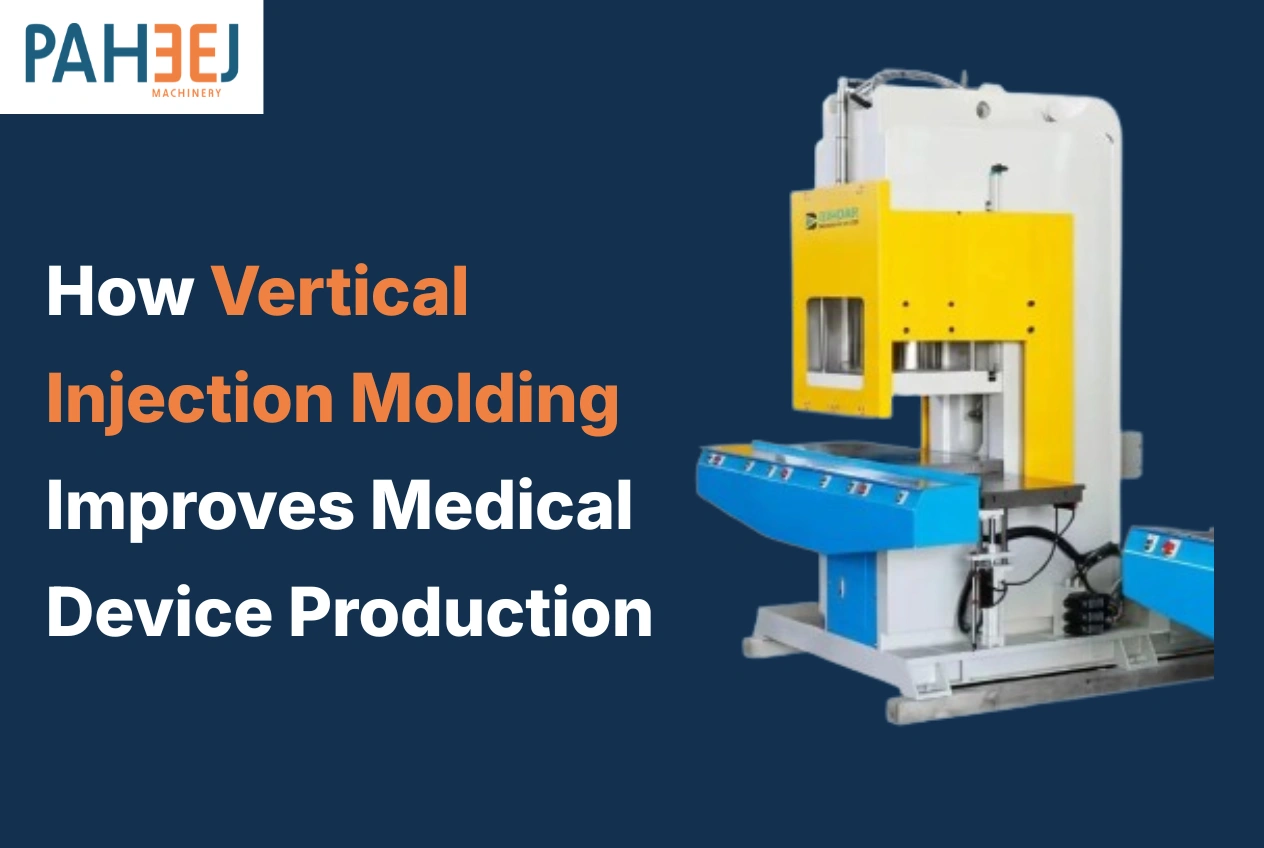
Vertical injection molding machines offer several design advantages that make them well suited for medical manufacturing environments.
1. Precise Insert Positioning
Many medical devices incorporate metal inserts, electrical contacts, or threaded components that must be accurately positioned before plastic is injected into the mould.
The vertical clamping design uses gravity to help hold inserts securely in place, reducing the risk of movement during mould closing. This improves insert alignment and contributes to greater dimensional consistency across production batches.
These capabilities make vertical injection molding an excellent choice for insert and overmolding applications, particularly in the production of medical connectors, diagnostic equipment, and precision electronic components used in healthcare.
2. High Repeatability for Consistent Production
Medical manufacturing depends on producing identical components throughout long production runs. Vertical injection molding machines support this requirement through stable machine movements, controlled injection parameters, and repeatable molding cycles.
Consistent process control helps manufacturers achieve:
- Uniform part dimensions
- Reliable product quality
- Reduced process variation
- Improved production efficiency
High repeatability also reduces the need for frequent process adjustments, supporting efficient production while maintaining strict quality standards.
3. Compact Machine Design for Automated Production
Automation plays an increasingly important role in medical manufacturing by reducing manual handling and improving production consistency.
The compact layout of vertical injection molding machines simplifies the integration of robotic loading systems, pick-and-place units, and automated part removal. This allows manufacturers to maintain continuous production while reducing operator involvement in repetitive tasks.
Automation also contributes to consistent cycle times and supports high-volume manufacturing of medical components.
4. Clean and Controlled Manufacturing Environments
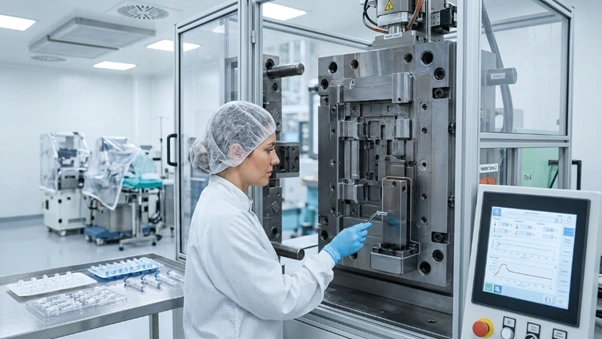
Many medical products are manufactured in controlled production environments where cleanliness and process stability are essential.
The compact design of vertical injection molding machines supports organized production layouts and efficient material flow. Their open mould access also allows easier integration with automated systems that reduce manual contact with molded parts.
Combined with appropriate manufacturing procedures, these machines help support the clean production environments commonly required for medical device manufacturing.
Common Medical Devices Manufactured Using Vertical Injection Molding
Vertical injection molding machines are used to manufacture a wide variety of medical products that require precision, repeatability, and reliable insert molding.
Medical Connectors
Medical connectors often contain metal terminals that require accurate insert placement. Vertical injection molding provides stable positioning and consistent overmolding for these precision assemblies.
Catheter Components
Catheter fittings and connector parts require precise dimensions and smooth surface finishes. Vertical machines support the consistent production needed for these critical medical applications.
Syringe Parts
Many syringe components are manufactured through precision injection molding processes that demand repeatable dimensions and reliable production quality.
Diagnostic Equipment Components
Plastic housings, sensor holders, and connector assemblies used in diagnostic equipment often require complex geometries and accurate molding to ensure proper device performance.
Surgical Instrument Handles
Surgical tools frequently combine plastic materials with metal inserts to improve strength and ergonomics. Vertical injection molding supports accurate insert placement while maintaining consistent product quality.
Wearable Medical Device Housings
Medical monitoring devices and wearable healthcare products require lightweight, durable plastic housings with precise dimensions. Vertical injection molding enables manufacturers to produce these components efficiently while maintaining high quality standards.
Vertical Injection Molding vs Other Machine Configurations for Medical Manufacturing
Different injection molding machine configurations can be used for medical production, but their suitability depends on the application.
|
Feature |
Vertical Injection Molding |
Horizontal Injection Molding |
|
Insert Stability |
High |
Moderate |
|
Automation Compatibility |
Excellent |
Good |
|
Precision Components |
Excellent |
Good |
|
Floor Space |
Compact |
Larger |
|
Medical Insert Molding |
Highly Suitable |
Application Dependent |
Vertical injection molding is particularly effective for insert molding and precision medical components where stable insert positioning and repeatable production are priorities. Horizontal machines remain suitable for many standard plastic parts, especially those without inserts or complex assembly requirements.
Selecting the appropriate machine depends on component design, production volume, automation requirements, and manufacturing objectives.
Best Practices for Medical Injection Molding Operations
Achieving consistent quality in medical manufacturing requires more than selecting the right machine. Well-controlled production processes play an equally important role.
Manufacturers can improve production consistency by following these best practices:
- Validate molding parameters before production begins.
- Use medical-grade materials that meet application requirements.
- Maintain moulds and machine components regularly.
- Perform routine dimensional and visual quality inspections.
- Integrate automation where practical to reduce handling variation.
- Standardize setup procedures across production shifts.
These practices help maintain stable production conditions while supporting consistent product quality and efficient manufacturing operations.
Conclusion
Medical device manufacturing requires production processes that deliver precision, consistency, and long-term reliability. Vertical injection molding machines support these requirements through accurate insert positioning, repeatable molding cycles, compact machine layouts, and automation-friendly designs.
Whether producing medical connectors, diagnostic equipment, surgical instruments, or wearable healthcare components, selecting the appropriate vertical injection molding machine helps manufacturers achieve consistent quality while supporting efficient production operations.
Paheej Machinery offers advanced vertical injection molding machines engineered to support precision manufacturing across medical, electronics, automotive, and other demanding industrial applications, helping manufacturers achieve reliable, efficient, and high-quality production.
Frequently Asked Questions (FAQs)
Why is vertical injection molding used for medical devices?
Vertical injection molding is widely used because it provides precise insert positioning, repeatable production cycles, and efficient automation integration. These capabilities help manufacturers produce medical components with the consistency and accuracy required for demanding healthcare applications.
What medical products are made using vertical injection molding?
Vertical injection molding is commonly used to manufacture medical connectors, catheter components, syringe parts, surgical instrument handles, diagnostic equipment components, and wearable medical device housings.
Is vertical injection molding suitable for insert molding?
Yes. The vertical clamping design helps hold inserts securely during mould closing, making vertical injection molding particularly suitable for insert molding applications requiring accurate positioning and repeatable production.
Can vertical injection molding support automated medical production?
Yes. Vertical injection molding machines are compatible with robotic loading systems, automated insert placement, and pick-and-place equipment. These automation capabilities improve production consistency while reducing manual handling.
How does vertical injection molding improve product consistency?
Stable machine movements, controlled process parameters, and repeatable molding cycles help produce uniform parts throughout long production runs. This reduces variation, improves dimensional accuracy, and supports reliable medical device manufacturing.