
A Buyer’s Guide to Machine Signal
Compatibility for Mould Protector Vision Camera Systems
A vision camera for mould protection can have excellent resolution and still fail to protect your mould. If the camera inspects at the wrong point in the cycle, or its signal does not reach the mould-close interlock, it may detect a defect without preventing mould damage. Machine signal compatibility determines whether the camera and injection moulding machine can exchange the right signals at the right time.
This guide explains which signals a mould protector needs, the interfaces and electrical details that affect installation, and what to check before you buy. For camera and lighting requirements, see our guide on choosing the right mould protector vision camera system.
Key Takeaways
- Mould open complete and ejector back are the two main signals used for post-ejection inspection.
- Voltage, PNP/NPN type and isolation affect how much wiring work a specific machine needs.
What Is Machine Signal Compatibility?
Machine signal compatibility is the ability of a mould protector to exchange the right electrical signals with an injection moulding machine at the right time in each cycle. It involves two types of signals:
- Inputs from the machine tell the camera when the mould is open and ready to inspect.
- Outputs from the camera tell the machine whether it is safe to close the mould.
How a Mould Protector Uses Machine Signals
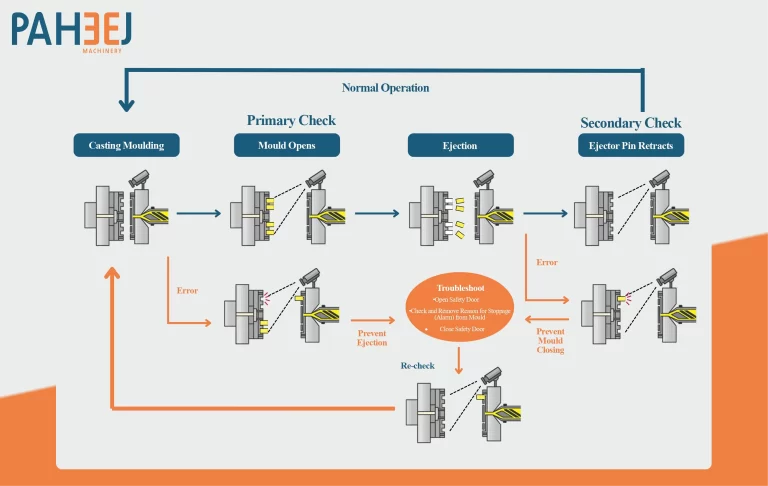
A vision mould protection system relies on machine signals to determine when to inspect. Through digital I/O signals, the machine tells it when the mould reaches the required inspection stage. The camera captures an image, compares it with a stored reference, and sends the inspection result to the machine controller.
In most setups, the key inspection happens after ejection. Once the mould is fully open and the ejectors have retracted, the mould inspection vision camera confirms that every cavity is empty. Other checks, such as insert placement, happen at a different stage of the cycle. The mould-close permit is issued only when the configured inspection conditions are satisfied.
Input Signals the Camera Needs from the Machine
Key Inputs
For most post-ejection inspection setups, two key inputs are commonly required:
- Mould open complete: confirms that the moving platen has reached its fully open position.
- Ejector back: confirms that the ejector stroke has finished.
If inspection begins before the ejectors retract, moving pins may trigger false alarms.
Additional Inputs
Depending on the mould, a mould-close start (close request) signal is also useful. The inspection result must be ready before the machine starts closing, and the interlock must prevent closure until the inspection passes.
Output Signals and the Mould-Close Interlock
The mould-close permit
The key output is the mould-close permit. It allows closure only when the configured inspection conditions are satisfied. Confirm that your machine has an input that actually blocks mould closing. An alarm lamp or buzzer isn’t enough: it warns the operator, but the mould can still close.
The permit should also be fail-safe: if the camera loses power, a cable breaks or the controller restarts, the permit should drop and the machine should not close. Ask every supplier to demonstrate this under each fault condition, and have it validated by a qualified engineer.
Do not assume a camera output is safety-rated: unless verified for that purpose, treat it as an additional protection layer and keep the machine’s own safety circuits in place.
EUROMAP 67, EUROMAP 12 and SPI Interfaces
Many machines expose cycle signals through a standard robot interface, and a mould protector can often use the same port.
EUROMAP 67 | A common robot interface on many modern machines. Typically carries mould open, ejector and enable-close signals on a standard connector. |
EUROMAP 12 | An older electrical robot interface found on some older machines. Confirm the pinout before connecting. |
SPI / Plastics Industry Association interface | Check the applicable robot-to-machine interface specification and confirm the connector, pin assignments and signal requirements for your machine. |
A matching interface name does not guarantee compatibility. What matters is the actual pinout and the configuration of your machine.
Data interfaces such as EUROMAP 63 and EUROMAP 77 serve data-exchange purposes. EUROMAP 77 uses OPC UA for communication between injection moulding machines and manufacturing execution systems (MES). Do not assume they provide a suitable mould-close interlock; use a properly engineered and verified control interface for that. See the official EUROMAP technical recommendations.
Electrical Compatibility: Voltage, PNP/NPN and Isolation
Two systems may both support EUROMAP 67 but still require different wiring or configuration. Check these points:
- Signal voltage: many modern machines use 24 V DC logic. Some older ones use 110 V or 230 V AC relay circuits that need interface relays or opto-isolators.
- Signal type: outputs can be sourcing (PNP, switching +24 V to the input) or sinking (NPN, switching to 0 V). The camera’s inputs must match or accept both.
- Mould-close permit output: a potential-free (dry) relay contact does not supply its own voltage. It can often work with different input types, provided the contact ratings and the machine’s wiring requirements are compatible. A powered transistor output must match the machine’s input type.
- Galvanic isolation: protects the camera controller from electrical noise and ground loops.
Compatibility Across Different Injection Moulding Machines
- All-electric machines: these often run fast cycles, leaving little time between the ejector-back signal and the start of mould closing.
- Vertical and rotary-table machines: these need table-position signals and either a camera per station or a suitable mount.
- Multi-component and 2K machines: these machines may require additional signals and multiple inspection points during each cycle.
Paheej Machinery’s Mould Protector Vision Camera System
Paheej Machinery’s mould protector vision camera system is designed for integration with compatible vertical injection moulding machines, whether electric, hydraulic or hybrid, subject to interface and electrical verification. When the system detects a configured defect, it signals the machine to inhibit mould closing, provided the required interlock has been correctly installed and validated.
What the system inspects
The system detects:
- Missing parts or unfilled cavities
- Parts not fully ejected
- Incorrect or incomplete slide-core movement
- Ejector pin retraction problems
- Insert misplacement before injection
- Abnormal flash
- Short shots or partially filled parts
The required signals depend on the mould design and inspection sequence. Post-ejection checks generally rely on mould-open and ejector signals, slide checks need slide-position timing, and insert checks need a trigger before injection.
Common Integration Mistakes
- Triggering on mould open alone. The camera inspects while ejector pins are still moving, raises false alarms, and operators eventually bypass it.
- Wiring the output only to an alarm lamp. The mould can still close.
Practical Compatibility Checklist
Use this checklist when evaluating a mould protection vision camera system:
- Machine make, model, controller and interface type recorded
- Signal voltage and PNP/NPN type confirmed
- Mould open complete and ejector back signals available
- Input that blocks mould closing identified
- Gap between ejector back and mould-close start compared with the system’s response time
- Mould-close permit behaviour on power loss demonstrated by the supplier
Conclusion
Choosing a mould protector is as much an electrical decision as an optical one. Start by checking your machines, not just the product brochure: list each press, its interface, its signal type and where mould closing can be blocked, then hold every supplier to the same checklist.
Not sure what your machines need? Send us your machine make, model, and robot-interface details, and we’ll help you identify the wiring and interface requirements for your setup. Email info@paheej.com and the Paheej Machinery team will reply within 24 hours.
Frequently Asked Questions (FAQs)
Which injection moulding machines is Paheej Machinery’s mould protector compatible with?
It is designed for integration with compatible vertical injection moulding machines, whether electric, hydraulic or hybrid, subject to interface and electrical verification. Compatibility depends on each machine’s interface and signal type, so share the make and model, and we will confirm what your setup needs.
Which two signals are essential for post-ejection inspection?
Mould open complete and ejector back. If the camera inspects before the ejectors retract, it sees moving pins and raises false alarms.
Does EUROMAP 67 support guarantee compatibility?
No. A matching interface name does not guarantee compatibility. Pinouts, voltage and PNP/NPN type vary, so check your machine’s actual configuration.
Can an alarm lamp or buzzer stop the mould from closing?
No. It only warns the operator. The output must go to a machine input that actually blocks mould closing.