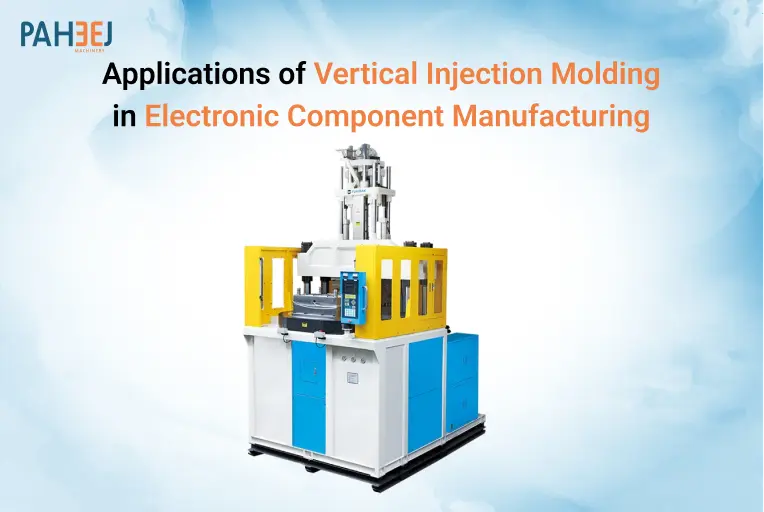
Vertical Injection Molding in Electronic Component Manufacturing
Electronic Component manufacturing depends on plastic components that are dimensionally precise, mechanically reliable, and consistent across very high production volumes. From connectors and terminals to sensor housings and PCB-mounted components, most of these parts combine plastic with metal inserts, wires, or conductive elements. This is exactly the kind of production challenge that vertical injection molding machines are built to address.
Because of their vertical clamping orientation, gravity-assisted insert placement, and compact footprint, vertical injection molding machines have become a preferred choice for manufacturers producing precision electronic component and electromechanical components. This article looks at where vertical injection molding is used across electronic component manufacturing, why it fits this industry so well, and what manufacturers should evaluate before investing in a machine — including how vertical injection molding machine price is determined.
Key Takeaways
- Electronic Component manufacturing relies on precision, insert stability, and high-volume repeatability — all strengths of vertical injection molding.
- Vertical injection molding is widely used for connectors, terminals, wire overmolding, switches, sensors, PCB components, and electronic component housings.
- Gravity-assisted insert placement and open mould access make vertical machines well suited to insert molding, overmolding, and automation.
- Vertical injection molding machine price depends on clamping force, mould configuration, automation, and insert requirements — not a fixed rate.
- Vertical injection molding machine price in India also factors in local sourcing, automation needs, and service considerations.
- A requirement-based quotation, rather than price-only comparison, is the practical way to select the right machine.
Why Precision Matters in Electronic Component Manufacturing
Electronic components are typically small, geometrically complex, and produced in very large batches. A connector housing, terminal block, or sensor cover must meet tight dimensional tolerances so it fits correctly with mating parts and maintains stable electrical contact — even a fraction-of-a-millimeter shift in an embedded pin or terminal can cause assembly failures or field reliability issues.
Because production runs are often high-volume and continuous, manufacturers need a molding process that repeats the same result across long runs without drift, while supporting automated handling and inline quality checks. This combination of tight tolerance, insert accuracy, and repeatability is a major reason electronic component manufacturers evaluate vertical injection molding for precision components rather than defaulting to conventional horizontal setups.
Why Vertical Injection Molding Is Suitable for Electronic Component Manufacturing
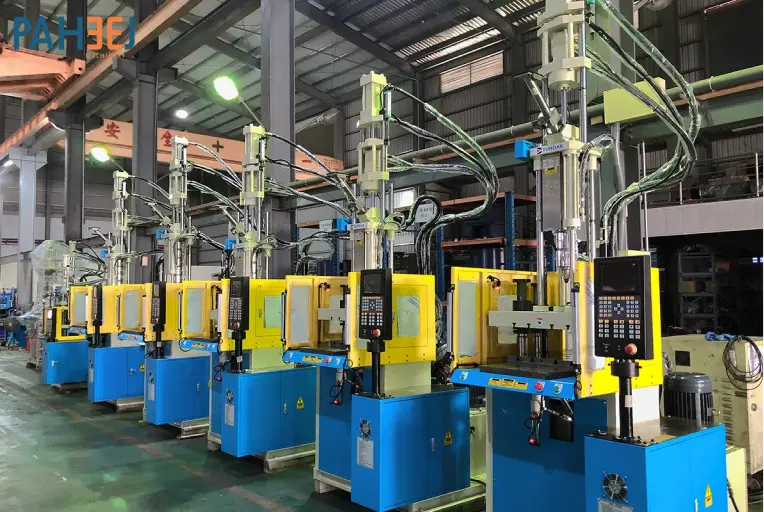
Vertical injection molding machines position the mould horizontally between an upper and lower platen that close vertically. This orientation offers several characteristics that align closely with the demands of electronic component production.
Gravity-assisted insert stability: Because the mould opens and closes on a vertical axis, inserts placed into the lower mould half are held in position by gravity rather than relying solely on mechanical clamps. This reduces insert shift during mould closing, which is particularly valuable when placing small terminals, thin metal contacts, or delicate wire ends.
Open, accessible mould area: The horizontal mould-parting layout of a vertical machine gives operators and robotic systems clear, top-down access to the mould cavity. This makes it easier to place inserts manually or through automation, and simplifies the integration of pick-and-place systems for repetitive electronic component production.
Compact machine footprint: Vertical machines generally require less floor space than horizontal machines of comparable tonnage, since the clamping unit occupies vertical rather than horizontal space. For electronic component manufacturers running multiple molding cells alongside assembly and testing lines, this compact layout supports better use of factory floor area.
Compatibility with rotary and shuttle tables: Many vertical machines can be configured with rotary or shuttle tables, allowing insert loading to happen on one station while molding occurs on another. This is especially useful for insert-heavy electronic components where loading time would otherwise slow down the cycle.
These characteristics explain why insert molding and overmolding — two processes central to electronic component manufacturing — are so closely associated with vertical machine platforms. Paheej’s dedicated resource on insert and overmolding applications covers this relationship in more detail.
Major Applications of Vertical Injection Molding in Electronic Component Manufacturing
Vertical injection molding is used across a wide range of electronic component and electromechanical components, including:
- Electrical Connectors — Connector housings contain multiple metal pins that must stay precisely positioned while plastic is injected around them; gravity-assisted insert stability helps maintain pin alignment for proper mating and electrical continuity.
- Terminals and Terminal Blocks — Thin metal strips embedded in a moulded plastic body are prone to shifting under lateral clamping forces, so the vertical orientation supports more consistent dimensional accuracy.
- Wire and Cable Overmolding — Overmolding a plastic body around a wire or cable end, common in sensor cables and harness connectors, requires the wire to stay fixed during injection; vertical machines make it easier to route and secure wires before the mould closes.
- Switches and Switch Components — Small moulded housings, actuators, and contact carriers rely on precision moulding for consistent switch feel, durability, and electrical performance.
- Sensor Components — Sensor housings and mounting brackets often need embedded metal contacts, making accurate insert placement essential, particularly for compact automotive and industrial sensors.
- PCB Connectors and Board-Mounted Components — Connectors mounted directly onto circuit boards demand tight tolerances so pin spacing matches board layouts exactly.
- Electronic component Housings and Enclosures — Control unit and junction box enclosures often incorporate mounting inserts or metal brackets that can be moulded in a single step.
- Automotive Electronic Components — Connectors, sensors, and control modules used in vehicles are frequently insert-moulded at the high volumes this sector demands.
- Other Precision Components — Cable clips, strain-relief parts, and potting shells that combine plastic with metal or conductive elements also benefit from vertical machines’ insert-handling strengths.
Key Benefits of Vertical Injection Molding for Electronic Component Manufacturers
Beyond individual applications, vertical injection molding offers several broader advantages for electronic component production environments:
- Precise insert positioning — Gravity and mould geometry work together to keep inserts stable during clamping, improving accuracy for connectors, terminals, and contacts.
- Reliable insert molding and overmolding — Vertical machines are well suited to processes that embed metal or conductive components directly into the moulded part.
- High repeatability — Controlled process parameters and stable machine movement support consistent part quality across long, high-volume production runs.
- Compact machine layout — A smaller footprint allows manufacturers to fit more moulding cells into existing floor space, which is valuable in dense electronic component production facilities.
- Automation compatibility — Open mould access makes it easier to integrate robotic insert loading, part removal, and downstream handling systems.
- Reduced secondary assembly — Producing insert-moulded or overmoulded parts in a single process step can reduce the number of separate assembly operations required after moulding.
- Improved production efficiency — Combining insert loading, moulding, and part ejection into a streamlined cycle supports higher throughput for high-volume electronic components.
Vertical vs Horizontal Injection Molding for Electronic Component Production
Both vertical and horizontal injection molding machines are used across the plastics industry, but their suitability varies by application. The table below outlines how the two configurations generally compare for electronic component manufacturing use cases.
Feature | Vertical Injection Molding | Horizontal Injection Molding |
Insert Stability | High — gravity-assisted | Moderate — depends on fixturing |
Automation Compatibility | Excellent, open mould access | Good, but access is more limited |
Suitability for Small Precision Parts | Excellent | Good |
Floor Space Requirement | Compact | Larger |
Suitability for Insert/Overmolding | Highly suitable | Application dependent |
Suitability for Large, Simple Parts | Limited by tonnage range | Well suited |
For electronic components that involve inserts, terminals, wires, or connectors, vertical injection molding is generally the stronger fit. Horizontal machines remain a practical choice for larger, simpler plastic parts that do not require insert placement. Manufacturers evaluating both options can review Paheej’s comparison of vertical vs horizontal injection molding machines to understand which configuration aligns with their specific component requirements.
Factors to Consider Before Buying a Vertical Injection Molding Machine
Selecting the right machine requires more than comparing tonnage figures. Electronic Component manufacturers should evaluate:
- Component design — the size, geometry, and insert requirements of the parts being produced
- Material compatibility — whether the machine and screw configuration suit the plastic resins used, including engineering-grade materials common in electronic component
- Insert handling method — manual loading, semi-automated fixtures, or fully robotic insert placement
- Mould configuration — single-cavity, multi-cavity, or rotary/shuttle table setups
- Production volume targets — expected cycle times and daily/monthly output requirements
- Automation readiness — compatibility with robotic arms, conveyors, and vision inspection systems
- After-sales support and machine serviceability — availability of spare parts and technical support
Reviewing the key components of a vertical injection molding machine can also help manufacturing and engineering teams understand how clamping units, injection units, and control systems influence overall machine performance before finalizing a purchase decision.
Vertical Injection Molding Machine Price
One of the most common questions from manufacturers evaluating this equipment is: what does a vertical injection molding machine actually cost? There is no single fixed answer, because vertical injection molding machine price depends on a combination of technical and application-specific factors rather than a standard catalog rate.
Machines built for simple, low-insert applications will differ significantly in price from machines configured with rotary tables, multiple injection units, or advanced automation interfaces for high-volume electronic component production. Two machines with similar clamping tonnage can carry very different price points once mould size, injection capacity, and automation features are factored in.
Factors Affecting Vertical Injection Molding Machine Price
Several variables directly influence the final price of a vertical injection molding machine:
- Clamping force and machine tonnage
- Injection unit capacity and screw configuration
- Mould size and cavity count
- Insert-handling and overmolding requirements
- Rotary table, shuttle table, or multi-station configurations
- Level of automation, including robotic integration
- Control system sophistication and process monitoring features
- Accessories such as material dryers, conveyors, or vision systems
- Application-specific customization requirements
Because these factors vary widely between projects, manufacturers are better served by requesting a requirement-based quotation rather than comparing machines solely on advertised purchase price. A machine that appears less expensive upfront may lack the automation or insert-handling capability needed for a specific electronic component, ultimately affecting total production cost and quality outcomes.
Machine Selection Considerations for Electronic Component Applications
When narrowing down machine specifications, electronic component manufacturers should evaluate the following in combination rather than in isolation:
Consideration | Why It Matters |
Clamping Force | Must match part size and cavity pressure requirements |
Injection Capacity | Should align with shot size and material type |
Mould Size | Determines compatible platen dimensions and tie-bar spacing |
Insert Requirements | Drives decisions on rotary tables or fixed insert stations |
Material | Engineering resins may require specific screw and barrel designs |
Production Volume | Impacts cavity count and cycle time targets |
Automation | Affects mould design, robot interfaces, and control integration |
Cycle Time | High-volume electronic component production depends on optimized, repeatable cycles |
Mould Configuration | Single-cavity, multi-cavity, or family moulds depending on part complexity |
Getting these variables right at the selection stage helps avoid costly reconfiguration later and ensures the machine can support both current and future production needs.
Best Practices for Electronic Component Injection Molding
Achieving consistent results in electronic component production depends on process discipline as much as equipment selection. Manufacturers can improve outcomes by following these practices:
- Validate insert placement and mould alignment before starting production runs
- Use materials suited to the electrical and mechanical demands of the component
- Maintain moulds and inserts to prevent wear-related dimensional drift
- Monitor cycle parameters continuously to catch process variation early
- Integrate automation for repetitive insert loading and part handling wherever practical
- Standardize setup and changeover procedures across shifts and operators
- Conduct routine dimensional inspection, particularly for connector pin spacing and terminal alignment
Following these practices alongside the right machine configuration helps manufacturers maintain consistent quality across long production runs.
How Paheej Helps You Buy the Right Vertical Injection Molding Machine
Choosing a vertical injection molding machine for electronic component manufacturing involves weighing multiple technical variables at once — component design, material, insert requirements, mould specifications, automation needs, and production targets. Paheej Machinery works with manufacturers to evaluate these factors together, rather than recommending equipment based on tonnage alone.
Paheej’s approach typically involves understanding the specific component or product being manufactured, the material being processed, expected production volume, and whether insert placement or overmolding is required. From there, machine configuration — including mould specifications, automation compatibility, and rotary or shuttle table requirements — can be assessed against the manufacturer’s actual application rather than generic assumptions.
As an industrial injection molding machinery supplier, Paheej offers a range of vertical injection moulding machines as well as all-electric injection moulding machines and multi-component/2K injection molding machines for manufacturers whose production needs extend beyond single-material components. Manufacturers evaluating equipment for electronic component production can get in touch with Paheej to discuss their specific component, material, and volume requirements and receive guidance suited to their actual application.
Conclusion
Electronic Component manufacturing places consistent demands on precision, insert stability, and repeatable high-volume production — requirements that vertical injection molding machines are well positioned to meet. From connectors and terminals to sensor components, PCB parts, and automotive electronic component assemblies, vertical injection molding supports the insert molding and overmolding processes that are central to producing reliable electronic components.
Selecting the right machine, however, depends on matching clamping force, injection capacity, mould configuration, and automation capability to the specific component being produced. Rather than comparing machines on price alone, manufacturers are better served by evaluating vertical injection molding machine price — including price in India — against their actual application requirements through a requirement-based quotation process.
Frequently Asked Questions (FAQs)
What is vertical injection molding used for in electronic component manufacturing?
Vertical injection molding is used to produce electronic components that combine plastic with metal inserts or wires, such as connectors, terminals, switches, sensor housings, and PCB-mounted parts, where accurate insert positioning is essential.
Why is vertical injection molding suitable for insert molding?
The vertical clamping orientation allows inserts to be held in place by gravity during mould closing, reducing insert shift and supporting more accurate, repeatable insert molding compared to some horizontal setups.
What electronic components can be produced using vertical injection molding?
Common components include electrical connectors, terminals, switches, sensor parts, PCB connectors, electronic component housings, and overmoulded wire or cable assemblies used in automotive and industrial electronic component.
How can Paheej help with vertical injection molding machine selection?
works with manufacturers to evaluate their specific component, material, insert requirements, and production volume, helping Paheej match these needs to the right machine configuration rather than recommending equipment based on tonnage alone.
Can vertical injection molding be used for wire overmolding?
Yes. Vertical machines make it easier to secure and route wires into the mould before closing, which helps produce consistent overmoulds with fewer alignment issues compared to less accessible mould orientations.