Reasons Why Vision Cameras Are More Reliable Than Traditional Sensors
Mould protection has always been a priority in injection moulding operations, but the tools used to achieve it have not always kept pace with production demands. Traditional sensors have served as the standard monitoring solution for years, offering basic detection across straightforward production environments.
As mould designs become more complex and cycle times decrease, limitations in traditional sensor-based protection become more significant. The financial impact of mould damage, including repair costs and production downtime, can be substantial and is further amplified by lost output. As a result, manufacturers are increasingly adopting vision-based camera systems as a more reliable alternative for monitoring and protection.
This article focuses on why vision cameras vs traditional sensors is not just a technology comparison, but a practical production decision.
Understanding Traditional Sensor-Based Mould Protection
Traditional mould protection relies on indirect monitoring methods:
- Pressure sensors detect abnormal force during mould closing, triggering a stop if resistance exceeds a set threshold
- Limit switches confirm that the mould has reached a defined open or closed position
- Proximity sensors detect the presence of objects within a defined range
- Mechanical detection identifies physical resistance during mould movement
These methods work reliably in basic, single-cavity environments with consistent parts and predictable cycles. For straightforward applications with limited inspection requirements, they remain a practical and cost-effective baseline.
The Limitations of Traditional Sensors
The problem is not that sensors fail. It is that they only detect what they are physically set up to measure, and nothing beyond that.
In practice, this creates real coverage gaps:
- Sensors detect force or position, not visual conditions inside the cavity
- They cannot confirm whether a part has fully ejected or is partially retained
- Flash, incomplete fills, and surface defects are invisible to sensor-based systems
- In multi-cavity moulds, sensors cannot isolate which cavity has an issue
- Complex mould geometries, deep cores, and insert operations fall outside reliable sensor range
- By the time a pressure anomaly is detected, contact between the mould and a retained part may have already caused damage
Traditional sensors react to a problem that has already begun. Vision cameras identify the condition before the mould closes.
Why Vision Cameras Provide More Reliable Detection
This is where Paheej Machinery’s Mould Protector Vision Camera System demonstrates a clear operational advantage.
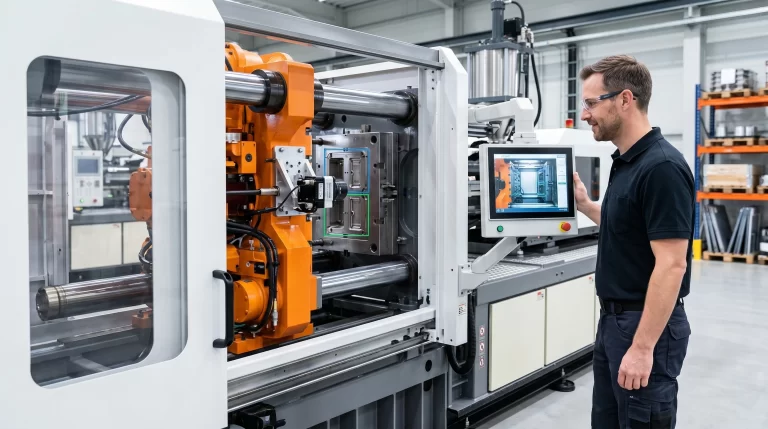
Complete visual inspection: Rather than inferring conditions from pressure or position data, Paheej Machinery’s vision system captures an actual image of the mould cavity after each cycle. It evaluates what is physically present, not what a sensor threshold assumes.
Real-time verification: The system confirms part ejection, cavity clearance, and insert positioning within the open window of each cycle. If a condition falls outside the defined parameters, a machine stop is triggered before the mould closes.
Consistent inspection every cycle: Unlike manual checks, which vary with operator attention and shift fatigue, Paheej Machinery’s vision system applies the same inspection standard across every cycle, every shift, every production run.
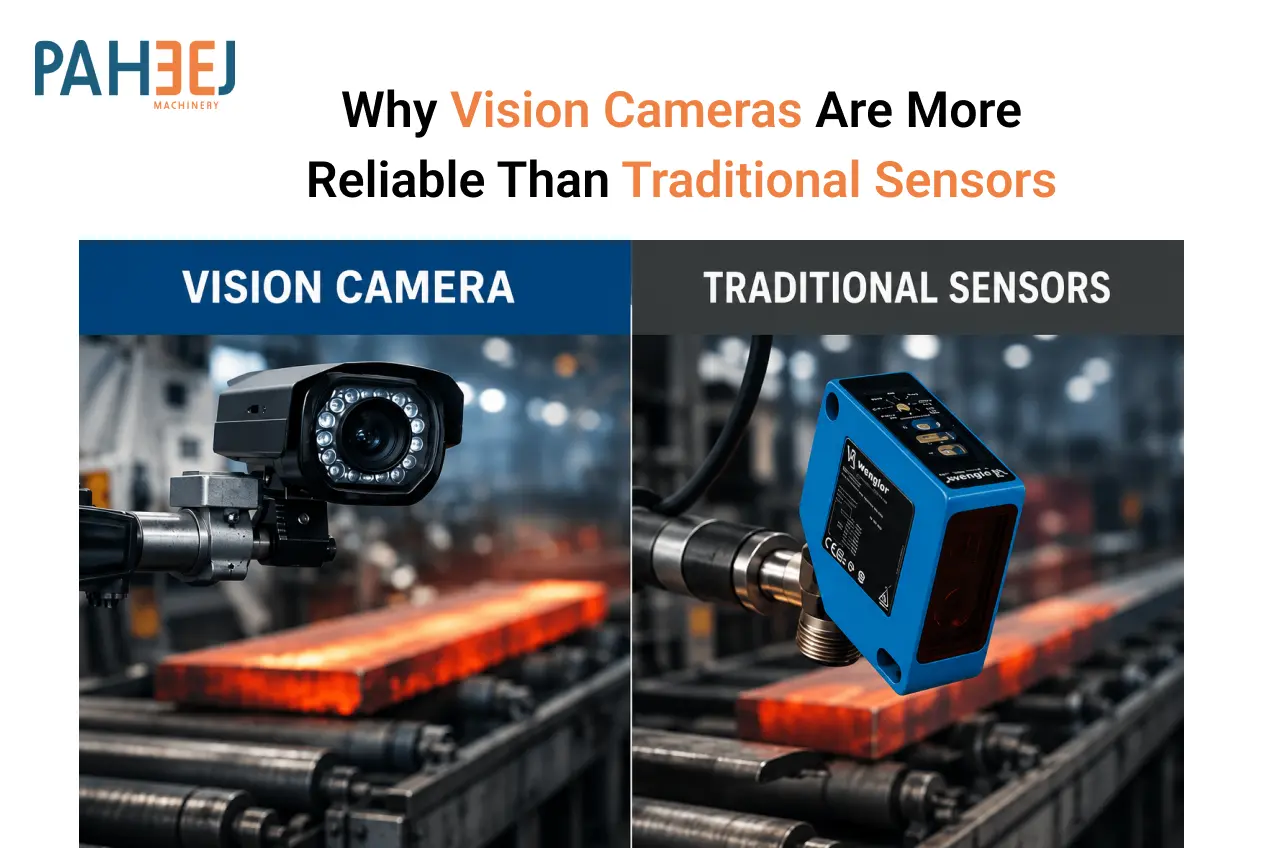
Vision Cameras vs Traditional Sensors: Key Differences
Capability | Traditional Sensors | Vision Cameras |
Part presence detection | Limited | Yes |
Insert verification | Limited | Yes |
Flash detection | No | Yes |
Multi-cavity monitoring | Limited | Yes |
Visual inspection | No | Yes |
Mould protection | Basic | Advanced |
The gap is not marginal. In applications where mould complexity and production speed increase, the difference in detection capability translates directly into production risk.
Better Protection for Modern Injection Moulds
Complex mould designs present the clearest case for vision-based protection. Multi-cavity moulds, insert moulding operations, and overmoulding applications all involve conditions that pressure sensors cannot reliably monitor. A misaligned insert or a partially retained part in one cavity creates a risk that sensor thresholds will not catch until the mould has already closed.
High-speed production compounds the problem. As cycle times decrease, the inspection window between mould opening and closing shrinks to seconds. Manual intervention is not feasible. Paheej Machinery’s vision system operates within that window automatically, without slowing the cycle.
Reduced mould damage risk is the direct outcome. Retained part detection, ejection verification, and insert position confirmation by Paheej Machinery’s system prevent the conditions that cause mould crashes, rather than reacting after contact has occurred.
Supporting Quality Control Beyond Mould Protection
Paheej Machinery’s Mould Protector Vision Camera System contributes to quality control beyond the immediate cycle. Each image captured becomes a production record, supporting traceability and process review. Consistent visual monitoring also identifies process variation early, before it develops into a recurring defect condition.
This extends the value of the system beyond mould protection into broader production consistency and quality assurance, areas where traditional sensors offer no equivalent capability.
When Should Manufacturers Upgrade to Vision-Based Mould Protection?
Some operational scenarios make the case clearly:
- Recurring mould damage incidents, even infrequent ones, indicate gaps in current protection coverage
- Multi-cavity production, where cavity-specific issues cannot be isolated by pressure monitoring alone
- High-speed moulding, where cycle windows are too short for reliable manual inspection
- Insert moulding operations, where the presence and position of the insert need verification every cycle
- Increasing quality requirements, particularly in automotive, medical, and electronics sectors, where traceability and defect rates are closely monitored
The decision to upgrade is ultimately a risk-management decision. As mould value and production complexity increase, the cost of inadequate protection rises accordingly.
Conclusion
The comparison between vision cameras vs traditional sensors is not about replacing one technology entirely. Sensors continue to serve a role in basic monitoring. But for manufacturers running complex moulds, multi-cavity tools, insert operations, or high-speed cycles, sensor-based protection alone leaves meaningful gaps.
Paheej Machinery’s Mould Protector Vision Camera System closes those gaps through visual verification, real-time detection, and consistent cycle-by-cycle inspection that traditional sensors cannot replicate. As production demands increase, that reliability becomes a competitive and operational necessity.
Paheej Machinery supports manufacturers with advanced mould protector vision camera systems designed to improve inspection reliability, mould protection, and production consistency across injection moulding operations.