How to Choose the Right Two-Platen Injection Molding Machines
Consistent part quality is a basic requirement in injection moulding operations. Even minor defects can affect product performance, customer acceptance, and downstream manufacturing efficiency. In high-speed, high-volume environments, defects are not always detected immediately.
Traditional manual inspection works well at low volumes and slow cycles. At production speed, it struggles. Operators cannot inspect every part on every cycle, and human attention is inherently inconsistent across long shifts. This is where vision camera systems have become a practical and increasingly standard part of modern injection moulding operations.
This article explains the most common injection moulding defects encountered in production and how vision camera systems are transforming mould protection by enabling early, consistent detection of defects.
Why Defect Detection Matters in Injection Moulding
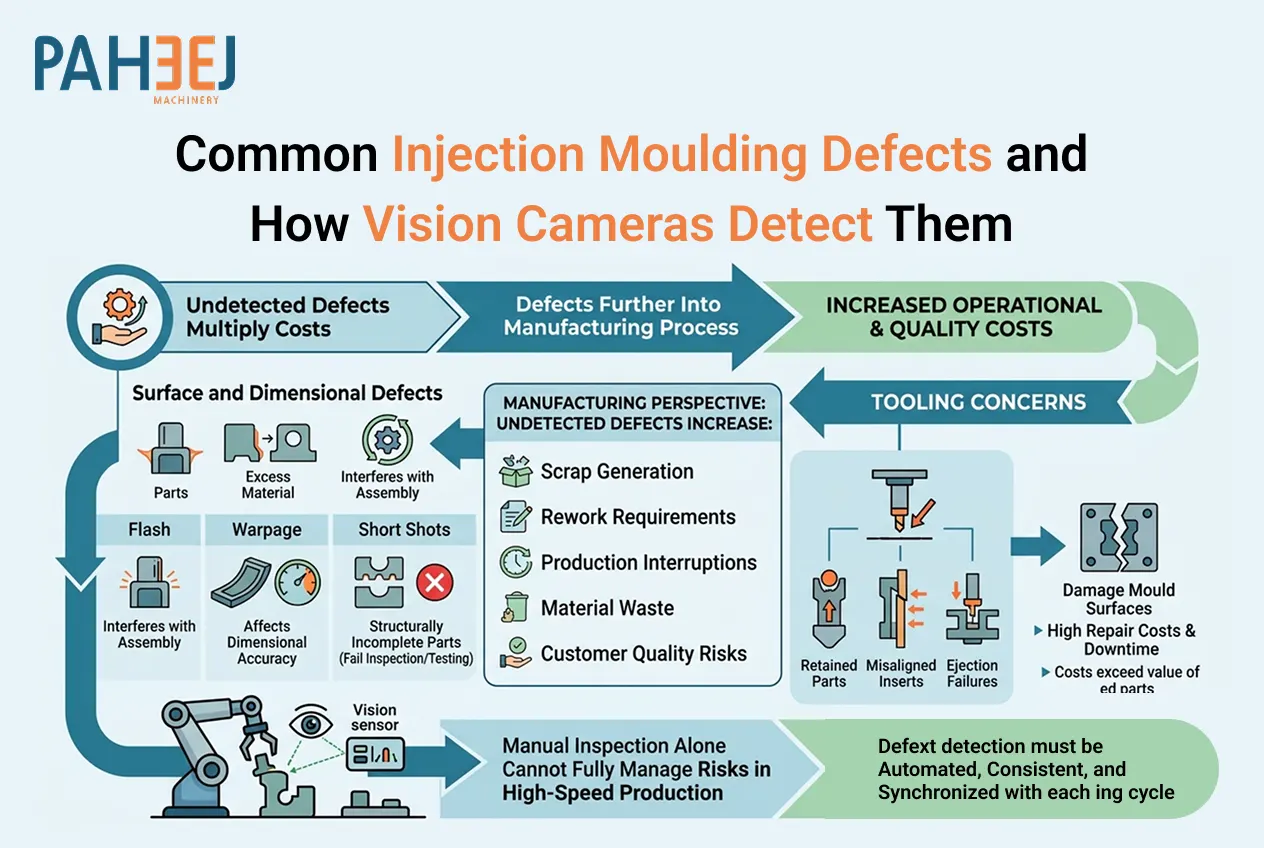
A defect that goes undetected during moulding does not disappear. It moves further into the manufacturing process, often increasing operational and quality-related costs.
Surface and dimensional defects directly affect end-use performance. Flash may interfere with assembly, warpage can affect dimensional accuracy, and short shots create structurally incomplete parts that fail inspection or functional testing.
From a manufacturing perspective, undetected defects increase:
- Scrap generation
- Rework requirements
- Production interruptions
- Material waste
- Customer quality risks
There is also a tooling concern. Retained parts, misaligned inserts, or repeated ejection failures can damage mould surfaces during the next cycle. The resulting repair costs and downtime often exceed the value of the ed parts themselves.
Manual inspection alone cannot fully manage these risks in high-speed production environments. Defect detection must be automated, consistent, and synchronized with each ing cycle.
Common Injection Moulding Defects in Manufacturing
Understanding common injection moulding defects helps manufacturers improve inspection accuracy and process consistency.
Flash
Flash appears as excess material along the parting line or around ejector areas. Insufficient clamping force, worn mould surfaces, or pressure imbalance during injection commonly cause it.
Flash often creates secondary trimming requirements and may affect assembly fit in precision applications.
Short Shots
Short shots occur when the mould cavity does not fill completely. Sections of the part remain incomplete or underdeveloped.
Typical causes include:
- Insufficient injection pressure
- Restricted material flow
- Material feed inconsistency
- Poor venting conditions
Sink Marks
Sink marks appear as visible surface depressions, usually in thicker wall sections where cooling occurs unevenly. These defects affect both surface appearance and structural consistency.
Burn Marks
Burn marks are dark discolorations caused by trapped gas or excessive material heating. They often appear near the end of flow paths or in thin sections with poor ventilation.
Warpage
Warpage refers to dimensional distortion after cooling. Uneven shrinkage, inconsistent cooling, or improper gate placement can cause parts to lose dimensional accuracy.
Ejection and Part Sticking Issues
Parts that fail to eject correctly create immediate production interruptions. Retained parts or partial ejection can damage the mould if not detected before the next cycle begins.
How Vision Camera Systems Detect Injection Moulding Defects
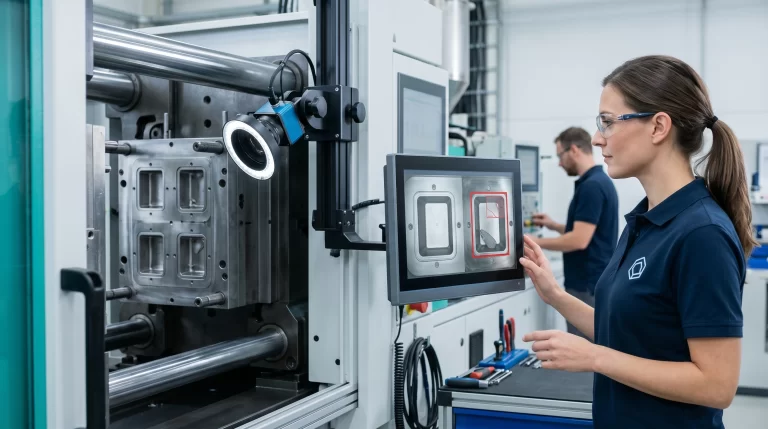
Vision camera mould protection system by Paheej Machinery addresses the main limitation of manual inspection by operating continuously and consistently at production speed.
Real-Time Image Monitoring
The system captures reference images during every ing cycle and compares them against predefined inspection parameters. Deviations outside accepted tolerances are identified immediately within the production cycle itself.
Surface and Shape Detection
Vision systems can identify:
- Flash along parting lines
- Short shots and incomplete filling
- Surface depressions from sink marks
- Visible burn marks or discolouration
- Shape deformation and warpage
Detection performance depends on camera resolution, lighting consistency, and inspection setup.
Part Presence and Ejection Verification
One of the most valuable functions of a mould protection vision system is cavity-clearance verification.
Before the mould closes, the system confirms that all parts have been fully ejected. If a retained part or partial ejection is detected, the machine can stop automatically before mould damage occurs.
Vision camera systems reduce tooling damage caused by unnoticed ejection failures.
Insert and Component Position Verification
In inserting operations, cameras verify that inserts are present and positioned correctly before injection begins.
Missing or misaligned inserts may result in defective parts, damage, or interrupted production cycles.
Advantages of Vision-Based Defect Detection
Vision inspection systems provide several operational advantages in injection moulding environments:
- Defects are detected during the cycle in which they occur
- Inspection consistency remains stable across shifts and production hours
- Scrap and rework rates are reduced
- Mould protection improves through retained-part detection
- Multi-cavity systems can be monitored simultaneously
- Quality data can be recorded for process monitoring and traceability
These advantages become increasingly important in high-speed and high-volume manufacturing operations.
Vision Cameras in High-Speed Injection Moulding Environments
As cycle times decrease, the available inspection window becomes smaller. Manual inspection cannot maintain reliable coverage at high production speed.
The vision protection system for high-speed production operates continuously, unaffected by cycle speed or operator fatigue.
Multi-cavity moulds pose an additional challenge for manual inspection because defects may occur in only one or two cavities while the remaining cavities continue to operate normally. Vision systems monitor all cavities simultaneously and identify cavity-specific issues before large volumes of scrap develop.
Real-time response is also important for mould protection. When a defective condition is detected, the system can trigger an alert or machine stop before the next cycle begins.
Automated Quality Monitoring in Modern Manufacturing
Manufacturers across automotive, medical, electronics, and consumer product industries increasingly rely on automated inspection systems to maintain quality consistency.
Vision-based inspection supports modern manufacturing requirements through:
- Continuous process monitoring
- Real-time defect detection
- Production traceability
- Improved process consistency
- Early identification of process drift
As manufacturing environments become more connected and automated, vision inspection systems continue to play a larger role in production quality control.
Conclusion
Common injection moulding defects such as flash, short shots, sink marks, warpage, and ejection failures directly affect product quality, manufacturing efficiency, and tooling reliability. Detecting these issues early is essential for maintaining stable production and reducing operational losses.
Vision camera systems provide continuous and consistent defect detection during high-speed injection moulding operations. By improving inspection accuracy, supporting mould protection, and reducing scrap generation, these systems help manufacturers maintain reliable and efficient production environments.
Paheej Machinery supports manufacturers with advanced mould protector vision camera systems designed to improve production reliability, defect detection, and quality consistency across injection moulding operations.
Frequently Asked Questions (FAQs)
1. What defects can vision camera systems detect in injection moulding?
Vision camera systems detect common injection moulding defects such as short shots, flash, missing inserts, incomplete ejection, part misalignment, contamination, and foreign particles. By analyzing every cycle in real time, they ensure defective parts are identified early and removed from production, improving overall quality and reducing scrap.
2. How do vision cameras prevent mould damage in injection moulding?
Vision cameras protect moulds by monitoring the mould area before each cycle closes. If they detect stuck parts, debris, or incorrect insert placement, they instantly stop the machine. This prevents mould crashes, reduces wear, and extends tool life, making production safer and more efficient.
3. Are vision camera systems better than traditional sensors for defect detection?
Yes. Unlike traditional sensors that only track pressure or movement, vision systems provide full visual inspection. They can detect surface and placement defects like flash, short shots, and missing parts that sensors may miss. This makes them more accurate and reliable for modern quality control.
4. What are the key benefits of using vision cameras in injection moulding?
Vision cameras improve product quality, reduce downtime, prevent mould damage, and lower production waste. They also enable continuous automated inspection, reduce manual effort, and improve manufacturing efficiency. Overall, they help manufacturers achieve consistent output with fewer defects.
5. Can vision systems accurately detect short shots and flash defects?
Yes. High-resolution vision systems with advanced algorithms can accurately detect short shots, flash, and incomplete fills in real time. With proper lighting and setup, they quickly identify defects during production, allowing immediate correction before large batches of defective parts are produced.