
Why Vision-Based Mould Protection is Essential for High-Speed Production
Modern manufacturing increasingly prioritises high-speed injection moulding to meet demanding production volumes and competitive delivery requirements. This shift toward faster cycle times creates significant operational advantages but introduces critical challenges in quality control and equipment protection.
Faster production cycles leave minimal time for manual error detection or intervention. A single undetected issue can damage expensive tooling or generate hundreds of defective parts within minutes. Vision camera mould protection has become essential for maintaining production stability and protecting tooling investments in high-speed manufacturing environments.
Challenges of High-Speed Injection Moulding
High-speed production amplifies risks that slower operations can manage through periodic inspection. Parts sticking in the mould, insert misalignment, and incomplete ejection become more frequent as cycle times compress. Operators have seconds or less to identify problems before the next cycle begins.
When errors occur, they propagate rapidly. A single stuck part can damage mould cavities or ejector systems within one cycle. The consequences extend beyond physical damage:
- Mould repairs halt production for hours or days
- Scrap accumulates rapidly across multiple defective cycles
- Quality issues escape detection until significant damage occurs
Traditional inspection approaches cannot maintain pace with high-speed production demands, creating critical gaps in quality assurance and equipment protection.
Why Traditional Protection Systems Are Not Enough
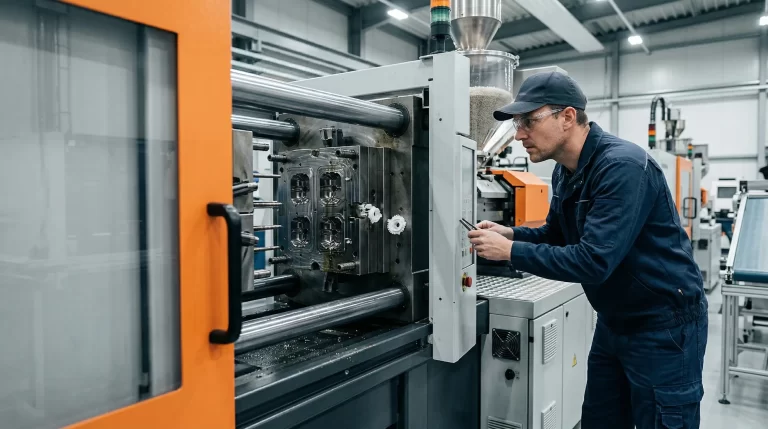
Conventional protection methods prove inadequate for high-speed injection moulding operations. Pressure sensors detect problems only after physical contact occurs, meaning damage happens before intervention. Manual inspection becomes impractical when cycle times drop below 10 seconds.
Traditional systems lack critical capabilities:
- No verification of part removal before mould closing
- No confirmation of insert positioning accuracy
- No detection of foreign objects or material residue
- No monitoring of ejector pin operation
High-speed production requires preventive detection that identifies issues before they cause damage. Reactive systems cannot provide the protection modern manufacturing demands.
How Vision-Based Mould Protection Solves These Challenges
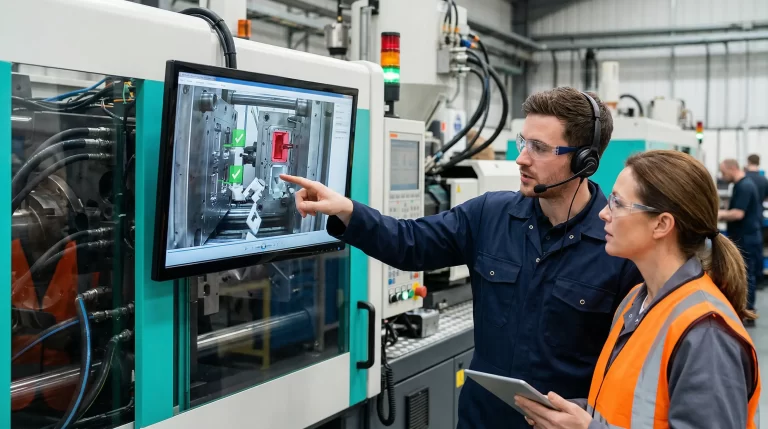
Vision Camera is transforming mould protection in injection moulding, addressing high-speed production requirements through real-time optical monitoring with high-speed processing capabilities. High-resolution cameras capture detailed images during each cycle, detecting abnormalities within milliseconds before mould closing occurs. The system triggers automatic machine interlocking when issues are detected.
This non-contact detection approach identifies problems before physical impact damages tooling. Multi-camera support enables monitoring of complex multi-cavity setups from multiple angles, ensuring comprehensive mould protection across all cavities.
Key detection capabilities include:
- Missing parts or unfilled cavities
- Parts not fully ejected
- Insert misplacement before injection
- Incorrect slide core movement
- Ejector pin retraction issues
- Abnormal flashes and short shots
Automated detection removes dependency on human monitoring, ensuring consistent protection regardless of cycle speed. The system integrates seamlessly with any injection moulding machine through reliable machine interlocking, automatically stopping production when abnormalities appear.
Impact on Productivity and Downtime
Vision Camera improves productivity and reduces machine downtime in injection moulding:
Preventing Mould Damage
Vision-based mould protection delivers measurable operational benefits by preventing mould crashes before they occur. Eliminating costly repair downtime preserves tooling precision throughout extended production runs. A single prevented crash can justify system investment through avoided repair costs alone.
Reducing Unplanned Downtime
Reduced unplanned downtime maintains production schedules and delivery commitments. Vision systems enable consistent production cycles without interruptions for quality issues or equipment damage. This reliability proves particularly valuable in high-volume operations where even brief stoppages affect overall output significantly.
Controlling Defect Propagation
Stopping defect propagation across multiple cycles prevents scrap accumulation and material waste. Early detection catches problems immediately rather than allowing hundreds of defective parts to accumulate. Quality issues are addressed before they compound into major production disruptions.
Supporting Automated Operations
Vision-based protection supports stable automated operations by providing reliable monitoring that keeps pace with production speeds. The technology enables manufacturers to maximise cycle efficiency without accepting increased risk of damage or quality problems.
Where Vision-Based Protection is Most Critical
Certain manufacturing scenarios benefit particularly from vision-based mould protection capabilities. High-speed production lines operating with cycle times under 10 seconds require automated monitoring that human operators cannot provide consistently.
Multi-cavity moulds present monitoring challenges where traditional sensors struggle to verify all cavities simultaneously. Vision systems inspect all locations within single image capture, ensuring comprehensive protection.
Critical application areas include:
- Insert moulding operations require precise component positioning
- Overmoulding processes where substrate retention is essential
- Automated manufacturing setups running with minimal supervision
- Precision component production where dimensional accuracy is critical
- High-volume operations where downtime costs escalate quickly
These applications share common characteristics: speed, complexity, and consequences where errors create significant operational impact. Vision-based protection addresses these demands effectively.
Conclusion
High-speed injection moulding increases both productivity potential and operational risk. Vision-based mould protection enables manufacturers to achieve faster cycle times while maintaining controlled, reliable operations. The technology provides preventive detection that traditional systems cannot match.
The combination of tooling protection, productivity maintenance, and production consistency makes vision systems essential investments for high-speed manufacturing. As cycle times continue decreasing and production demands intensify, automated optical monitoring becomes increasingly critical for operational success.
Paheej Machinery provides advanced mould protector vision camera systems designed to support high-speed, reliable, and efficient injection moulding operations across modern manufacturing environments.
Contact our team to learn how vision-based mould protection can enhance your production operations.
Frequently Asked Questions (FAQs)
1. What is a vision-based mould protection system in injection moulding?
A vision-based mould protection system uses high-resolution cameras and AI image processing to monitor each injection moulding cycle in real time. It detects defects like missing parts, short shots, or ejection errors, helping prevent mould damage, reduce scrap, and ensure consistent product quality in high-speed production.
2. How does a mould protector vision camera improve efficiency?
It improves efficiency by automatically inspecting every cycle without manual checks. The system detects defects in milliseconds and can stop the machine instantly, preventing repeated faulty cycles, reducing downtime, and minimizing material waste while maintaining high-speed, stable production.
3. What defects can a vision mould protection system detect?
It can detect defects such as missing parts, short shots, flash, stuck components, improper ejection, slide core errors, insert misplacement, and incomplete cavity filling. This ensures early detection and prevents mould damage and production losses.
4. What are the cost benefits of a vision-based mould protection system?
It reduces costs by preventing mould damage, lowering scrap rates, and minimizing downtime. It improves production yield, reduces rework, and extends mould life, delivering strong ROI over time in high-volume injection moulding operations.
5. How is vision-based mould protection different from sensor systems?
Unlike traditional sensors, vision-based systems use cameras for real-time visual inspection. They detect complex defects like multi-cavity issues or partial ejection that sensors may miss, offering higher accuracy, faster response, and complete cycle monitoring.