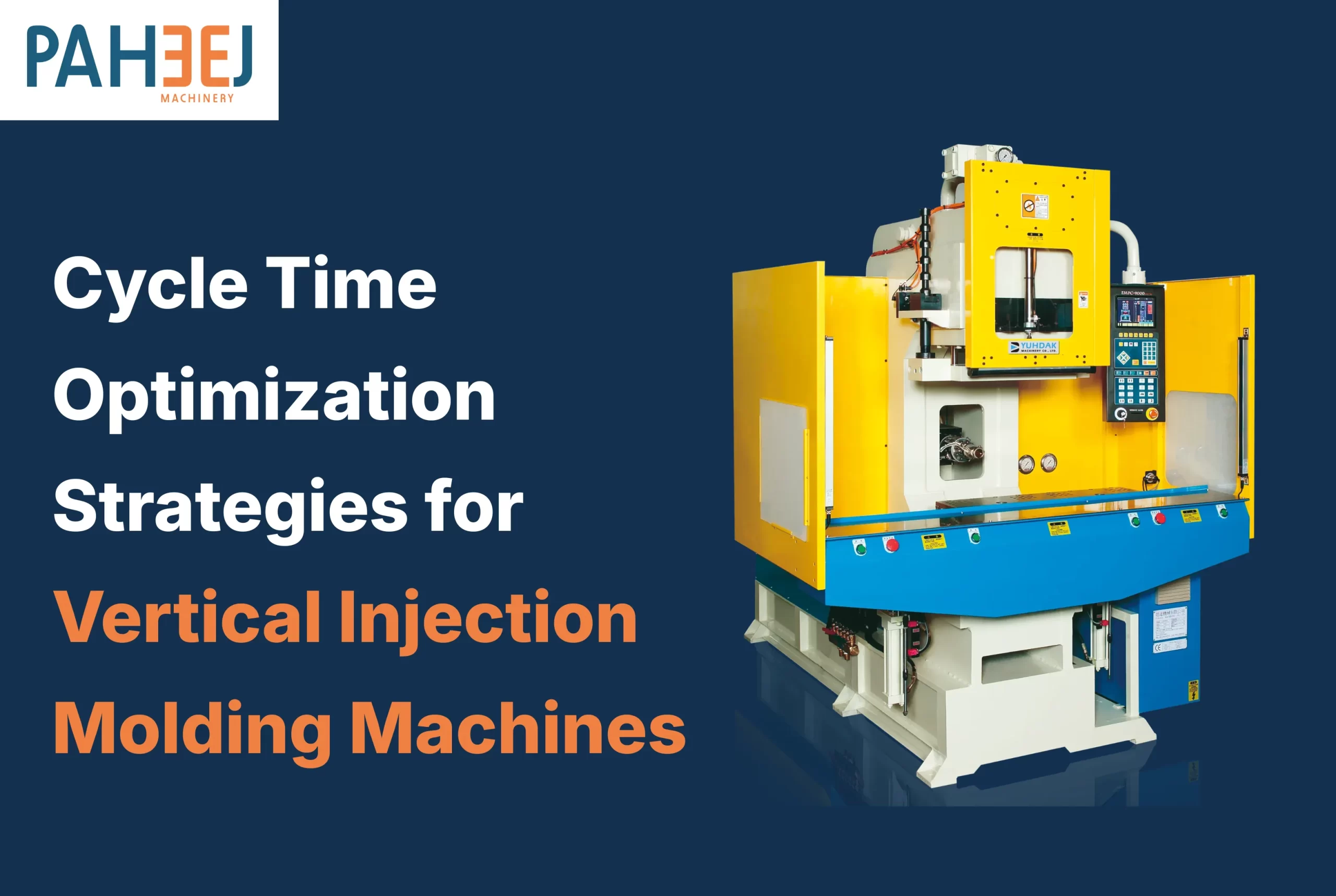
Cycle Time Optimization Strategies for Vertical Injection Molding
Cycle time represents the total duration required to complete one full injection molding cycle, directly influencing production capacity, operational costs, and manufacturing profitability. In competitive manufacturing environments, reducing cycle time while maintaining part quality determines overall equipment effectiveness and production throughput.
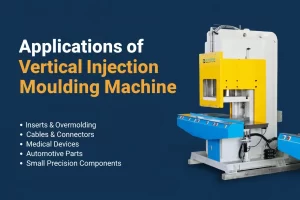
Paheej Machinery’s Vertical injection molding machines offer unique characteristics that influence cycle time optimization approaches. Understanding these factors and implementing targeted strategies enables manufacturers to improve efficiency without compromising quality standards. This article examines practical strategies that enhance cycle performance in vertical molding operations.
Understanding Cycle Time in Vertical Injection Molding
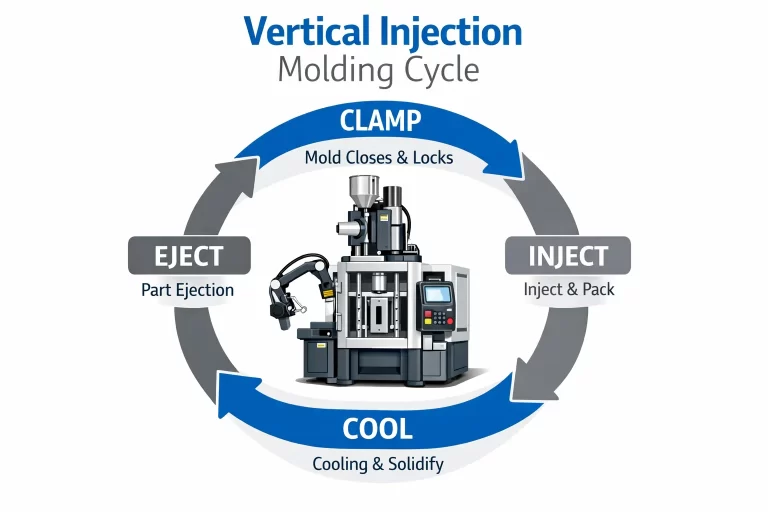
Injection molding cycle time comprises several distinct phases that together determine overall production speed. The mold closing phase positions the mold halves and establishes the clamping force. Injection time covers material delivery into the cavity. Cooling time allows the part to solidify sufficiently for ejection. The ejection phase removes the finished part and prepares for the next cycle.
Minor improvements in each segment contribute to significant gains in overall throughput. A five-second reduction across multiple phases can increase hourly production by 10-15% in high-volume operations. Vertical injection molding benefits, such as gravity-assisted insert alignment and accessible mold areas, influence optimization approaches, particularly for insert molding and multi-component applications.
Cycle Time Optimization in Vertical Injection Molding
Optimize Cooling Time for Faster Throughput
Cooling time typically represents the largest portion of total cycle time, often accounting for 50-70% of the complete cycle. Efficient thermal management directly impacts both cycle speed and part quality.
Effective cooling optimization strategies include:
- Efficient cooling channel design that maximizes heat transfer surface area
- Uniform temperature distribution preventing hot spots and warpage
- Strategic channel placement following part geometry
- Adequate flow rates maintaining consistent coolant temperature
- Advanced cooling circuits in critical mold areas
Stable cooling supports faster cycles while maintaining dimensional accuracy and surface finish requirements. Well-designed thermal management enables consistent part release and reduces stress-related defects that would otherwise extend cooling requirements.
Maintain Consistent Mold and Material Temperatures
Temperature stability throughout production runs proves essential for consistent cycle performance. Temperature fluctuations cause variations in material flow, cooling rates, and part dimensions, requiring longer cycles to compensate for inconsistency.
Critical temperature control areas include:
- Barrel zone temperatures maintain proper melt viscosity
- Mold surface temperatures ensure uniform heat extraction
- Insert areas when metallic components are present
- Nozzle temperature prevents premature material solidification
Consistent thermal conditions enable tighter process windows and predictable cycle behavior. This stability supports optimized parameters without the safety margins required to accommodate temperature variations during extended production runs.
Improve Injection and Pack/Hold Efficiency
Injection phase efficiency influences both cycle speed and part quality. Proper injection parameters ensure complete cavity filling with minimal time while establishing conditions for successful packing and holding.
Injection optimization considerations include:
- Injection speeds matched to cavity geometry and material characteristics
- Pack and hold pressures sufficient for dimensional stability
- Controlled deceleration before switching to the pack phase
- Pressure profiles preventing flash while ensuring complete filling
Precise control over injection phases prevents defects that would require longer cycles or additional quality measures. Optimized parameters balance speed with the material behavior necessary for consistent part production.
Streamline Ejection and Part Handling
Ejection efficiency becomes particularly important in vertical molding operations where the accessible mold area enables various automation approaches. Reducing ejection time and minimizing handling delays directly improves overall cycle performance.
Effective ejection strategies include:
- Synchronized ejector timing with mold opening sequences
- Automated part removal systems eliminate manual intervention
- Robotic handling for consistent part transfer
- Gravity-assisted ejection in vertical configurations
- Proper ejector pin design prevents part sticking
Automated systems maintain consistent ejection timing regardless of operator availability or attention, supporting steady production rates. Mechanical consistency eliminates the human variability that creates cycle time fluctuations in manual operations.
Integrate Automation and Real-Time Monitoring
Automation integration supports cycle time reduction through consistent, repeatable operations. Automated systems execute tasks faster and more reliably than manual processes while enabling parallel operations that reduce overall cycle duration.
Automation benefits include:
- Robotic part removal immediately after mold opening
- Automated insert feeding is positioned during the cooling time
- Integrated inspection systems check quality during cycles
- Consistent timing, eliminating human reaction delays
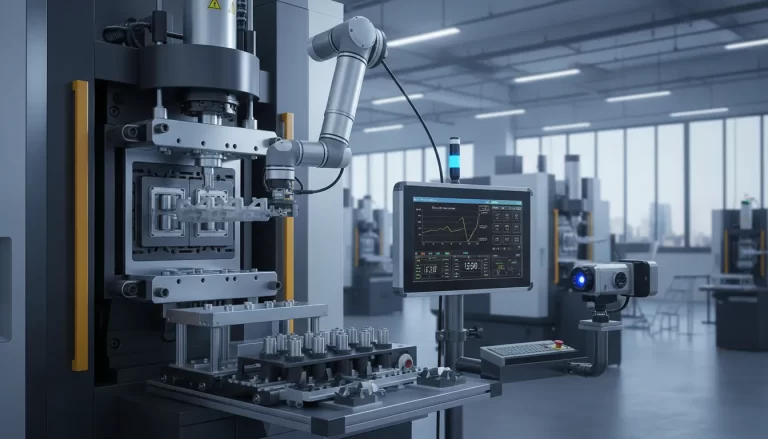
Real-time monitoring enhances optimization through continuous process feedback. Sensor systems detect temperature, pressure, and position variations that indicate developing issues. Vision camera systems provide mould protection while confirming successful cycles. Process data enables dynamic parameter adjustments, maintaining optimal conditions throughout production.
Standardize Procedures and Operator Training
Operator consistency influences cycle time stability across shifts and production runs. Well-trained personnel maintain established parameters, recognize process variations, and respond appropriately to changing conditions.
Standardization supports consistency through:
- Documented procedures for mold setup and changeovers
- Parameter verification protocols before production starts
- Shift-to-shift communication maintains process knowledge
- Recording of optimal parameters for different moulds and materials
Standard operating procedures reduce setup variations and ensure that successful parameter sets are consistently applied. This operational discipline prevents the trial-and-error approaches that waste time and generate scrap.
Continuous Improvement Through Data Analysis
Production data analysis identifies optimization opportunities not apparent during normal operations. Systematic review of cycle performance reveals patterns, trends, and improvement potential.
Data-driven optimization examines:
- Minor variations are developing over extended production runs
- Pattern recognition identifies common delays or inefficiencies
- Benchmarking current performance against historical baselines
- Correlation between parameter changes and cycle time results
Focusing on data patterns enables targeted improvements addressing specific bottlenecks. Incremental adjustments based on measured results compound into substantial throughput gains over time without the risks associated with major process changes.
Conclusion
Cycle time optimization in vertical injection molding requires systematic attention to multiple process elements. Cooling system efficiency, temperature stability, injection parameters, ejection consistency, automation integration, operator standardization, and data analysis each contribute to overall performance improvement.
Small improvements across multiple cycle phases compound into measurable gains in productivity and manufacturing profitability. A comprehensive optimization approach addresses all cycle components rather than focusing on single elements, creating cumulative benefits that significantly enhance operational efficiency.
Paheej Machinery provides advanced vertical injection molding machines and application expertise that help manufacturers optimize cycle times, increase throughput, and deliver consistent quality to address modern production challenges.